
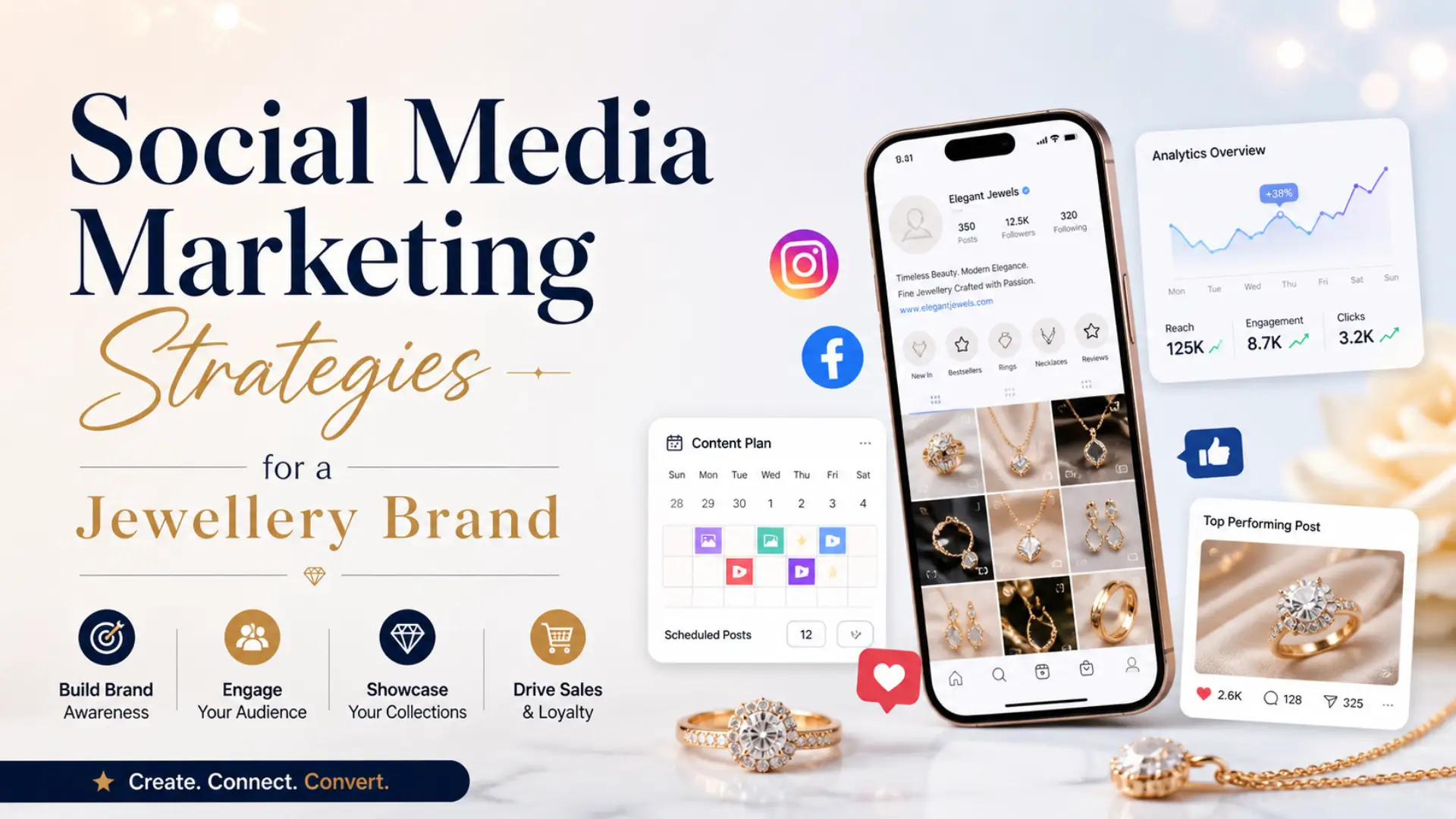
Jewellery is one of the most visual, emotional, and personal product categories in the world. People buy it to mark milestones, express identity, and give meaning to relationships. That makes social media an almost perfect channel for jewellery brands but only when used with intention.
A generic posting strategy will not cut through the noise in this space. The brands winning on Instagram, Pinterest, and TikTok right now are the ones treating social media as a storytelling platform, not just a product catalogue. This guide breaks down the strategies that actually move the needle for jewellery brands of every size.
Build a Visual Identity That Stops the Scroll
Before any strategy works, your feed needs to look like it belongs to one brand. Visual consistency is the foundation everything else is built on.
- Choose a signature colour palette — Pick two or three colours that appear across every post. Whether you shoot against white marble, dark velvet, or warm wood, that consistent backdrop becomes your brand signature before a single word is read.
- Invest in natural light photography — Jewellery catches and reflects light in ways that reveal craftsmanship. Natural light photography, even shot on a smartphone near a bright window, outperforms harsh studio lighting for most jewellery styles. Soft shadows add depth and texture.
- Create a consistent editing style — Apply the same preset or filter to every photo. Even a slight warmth adjustment or a consistent contrast level ties your grid together visually and makes your content instantly recognisable in a crowded feed.
- Use lifestyle shots alongside product shots — Flat-lays and white background images show the product. Lifestyle shots of people wearing the pieces show the feeling. A strong jewellery feed mixes both in a rhythm that keeps things visually interesting without losing brand coherence.
Master Instagram for Jewellery
Instagram was practically built for jewellery brands. The platform rewards beautiful imagery, aspirational content, and community-driven engagement — all natural strengths for this category.
- Post Reels of the making process — Behind-the-scenes content of jewellery being crafted, stones being set, or pieces being polished consistently outperforms static product posts on Reels. It builds trust and adds a layer of story to every piece you sell.
- Use carousels to tell a story — A carousel post showing a piece from every angle, or walking through the inspiration behind a collection, drives higher engagement than single-image posts. Carousels keep people swiping, which signals strong interest to the algorithm.
- Tag products in every post — Instagram Shopping lets you tag pieces directly in posts and Reels. This shortens the path from inspiration to purchase and keeps your brand shoppable without being pushy.
- Write captions that add context — Instead of just naming the piece and adding a price, share the story. What inspired the design? What is the occasion it was made for? Captions that give meaning to a piece create emotional connection with potential buyers.
- Engage in the first hour after posting — Responding to comments quickly in the hour after a post goes live signals activity to Instagram’s algorithm and pushes your content to more accounts. This one habit has an outsized effect on reach.
Use Pinterest as a Long-Term Traffic Engine
Pinterest works differently from every other platform. Content there does not disappear after 48 hours — a well-optimised Pin can drive traffic and sales for months or even years after it is posted.
- Create boards around lifestyle themes, not just products — Boards titled “Engagement Ring Inspiration,” “Anniversary Gift Ideas,” or “Layered Necklace Looks” attract people in active buying or planning mode. These searches have high purchase intent.
- Write keyword-rich Pin descriptions — Pinterest functions as a visual search engine. Descriptions that include natural language keywords (the exact phrases people search for) dramatically improve how often your Pins appear in relevant searches.
- Pin consistently rather than in bursts — Pinterest rewards accounts that post regularly over time. Scheduling five to ten Pins per day using a tool like Tailwind or Buffer produces far better results than posting fifty Pins in one sitting and going quiet for a week.
- Link every Pin directly to the product or collection page — Every Pin should be a direct path to a purchase. Linking to your homepage instead of the specific product page creates friction and loses the sale before it starts.
Build a TikTok Presence Around Storytelling
TikTok is the fastest-growing discovery platform for product brands right now, and jewellery performs exceptionally well there when the content leans into authenticity and story rather than polished advertising.
- Show the process, not just the product — Videos of jewellery being made, polished, packaged, or inspected perform consistently well. These process videos build brand credibility and generate genuine curiosity about the pieces.
- Share the story behind each collection — A 30-second video explaining the cultural, personal, or design inspiration behind a collection does more for brand loyalty than any promotional post. People connect with founders and stories before they connect with products.
- Use trending audio with relevant visuals — Pairing your jewellery footage with trending sounds dramatically increases the chance of appearing on For You pages outside your existing follower base. The visual does the selling; the audio does the distribution work.
- Answer customer questions in video form — Common questions like “How do I layer necklaces without tangling?” or “What is the difference between gold-filled and gold-plated?” make excellent TikTok content. Educational videos build trust and bring in audiences who are actively researching before buying.
Run Influencer and UGC Campaigns That Actually Convert
Paid advertising gets expensive fast. Influencer partnerships and user-generated content are often more effective for jewellery brands because the trust factor is built in.
- Work with micro-influencers in your niche — Influencers with 5,000 to 50,000 followers in fashion, lifestyle, or bridal content typically generate higher engagement rates and more authentic recommendations than larger accounts. Their audiences trust their opinions more, and the cost of partnership is far lower.
- Send pieces to customers and ask for photos — A simple post-purchase email asking happy customers to share photos of themselves wearing their pieces generates a steady stream of real-world content. Reposting this content with credit builds community and provides social proof without any production cost.
- Create a branded hashtag and promote it consistently — A dedicated hashtag gives your community a place to gather and gives you a searchable library of customer content. Feature the best submissions regularly to encourage ongoing participation.
- Run gifting campaigns around key dates — Valentine’s Day, Mother’s Day, anniversaries, and the holiday season are peak buying periods for jewellery. Gifting pieces to relevant creators two to three weeks before these dates puts your brand in front of gift-seeking audiences at exactly the right moment.
Use Content Series to Build Return Visits
One-off posts fade quickly. A content series gives your audience a reason to come back and look forward to what you post next.
- “Piece of the Week” features — Spotlight one piece every week with a story behind it. This creates a predictable content rhythm and keeps your product catalogue visible without feeling repetitive.
- Styling guides as recurring content — A weekly or biweekly post showing three different ways to style one piece, or how to build a layered look from scratch, drives saves and shares consistently. Saved posts are one of the strongest signals of content quality on Instagram.
- Customer spotlight series — Feature a customer, their story, and the piece they chose. These posts humanise your brand, celebrate your buyers, and generate the kind of emotional content that paid advertising struggles to replicate.
Do not chase every platform at once. Pick the one or two channels where your specific audience spends the most time and go deep there before expanding. A jewellery brand that masters Instagram and Pinterest will outperform one that posts average content across five platforms. Depth beats breadth, especially in the early stages of building a social media presence.
A Few Closing Thoughts
Social media marketing for jewellery brands is not about posting more. It is about posting with purpose giving every piece of content a reason to exist, a story to tell, and a clear next step for the person seeing it.
The brands that stand out in this space treat their feed as an extension of their brand experience. Every image, caption, and video should feel like it belongs to the same world and carries the same values as the physical pieces being sold.
Start with your visual identity, build one platform properly, and let the community grow from there. The results are slower than running ads but far more durable — and the customers who find you through great organic content tend to be the most loyal ones you will ever have.
Frequently Asked Questions
1. Which social media platform is best for a jewellery brand?
Instagram and Pinterest are the two strongest platforms for jewellery brands. Instagram drives engagement and community, while Pinterest functions as a long-term search and discovery engine with high purchase intent. TikTok is increasingly powerful for brands willing to invest in short-form video content.
2. How often should a jewellery brand post on social media?
Consistency matters more than frequency. Posting four to five times per week on Instagram with high-quality content outperforms daily posts that feel rushed or generic. On Pinterest, daily posting is recommended since the platform rewards volume more than most others.
3. Do jewellery brands need professional photography for social media?
Not always. Natural light smartphone photography works very well for jewellery, especially for lifestyle content. What matters most is consistent lighting, a clean background, and a steady editing style. Professional photography is worth investing in for campaigns, product launches, and hero images.
4. How do small jewellery brands compete with big ones on social media?
By leaning into story and authenticity. Large brands have bigger budgets but smaller jewellery brands have something more powerful — a founder story, a craft, a community. Content that shows the human side of the brand consistently outperforms polished advertising for audiences that care about what they are buying and who made it.
5. What type of content gets the most engagement for jewellery brands?
Process videos, customer photos, styling guides, and behind-the-scenes content consistently outperform straightforward product shots in terms of engagement. Content that gives people something useful, something to feel, or something to aspire to tends to perform best across all platforms.
6. Is paid advertising necessary for a jewellery brand on social media?
Not at the start. Organic content, influencer gifting, and community building can drive meaningful growth without a paid budget. Paid advertising becomes a powerful accelerator once you have an established visual identity and know which content resonates with your audience organically.
7. How important are hashtags for jewellery brands on Instagram?
Hashtags still play a role in discoverability, though their importance has decreased as Instagram leans more heavily on interest-based recommendations. Using a mix of broad tags like #jewellery and niche-specific ones like #stackingrings or #bridaljewellery gives your posts the best chance of being found by relevant audiences.