

Most businesses pour time and money into social media with no idea if it is paying off. This guide walks you through every step from the basic formula to platform-by-platform breakdowns so you can finally put a number on your social media results.
Why social media ROI matters more than ever
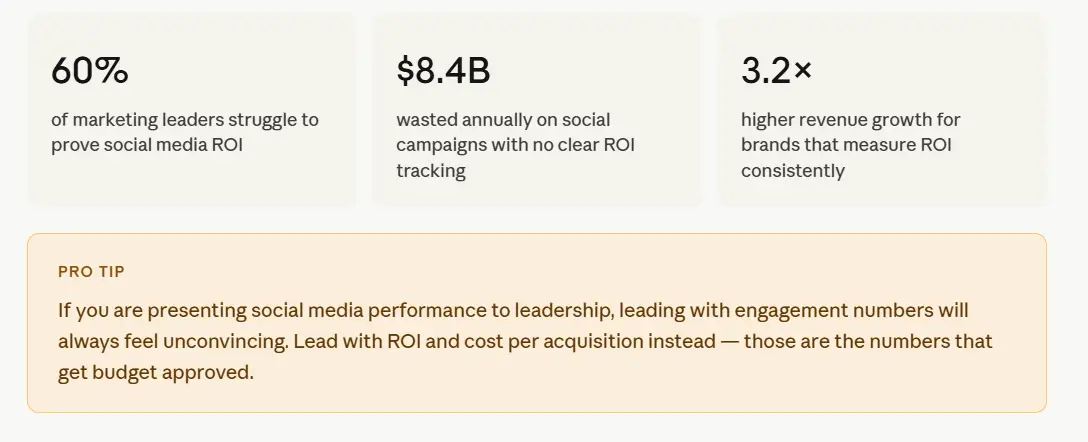
Social media budgets have grown steadily for over a decade. But as budgets grow, so does the pressure to prove that the spending is actually worth it. According to industry surveys, nearly 60% of marketing leaders say proving social media ROI is one of their top challenges and yet most teams still rely on engagement metrics that never show up in a profit and loss statement.
The real cost of ignoring ROI is not just wasted budget. It is lost opportunity. When you do not know what is working, you cannot double down on it. When you do not know what is failing, you keep funding it. ROI measurement is the feedback loop that turns guesswork into strategy.
What social media ROI actually means
Social media ROI is the measurable value your business gets from social media activity compared to what it costs to produce that activity. In simple terms: did you get back more than you put in?
ROI is not just about direct sales. Depending on your goals, it can cover lead generation, email sign-ups, app downloads, website traffic, brand sentiment, or customer retention. The formula stays the same only the definition of “value” changes based on what you are trying to achieve.
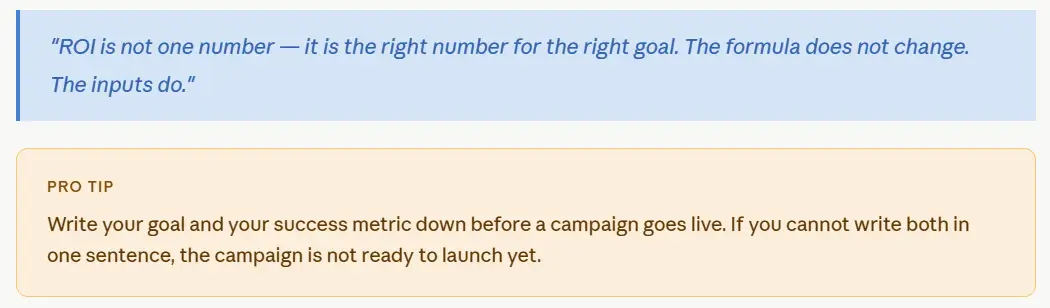
This is why setting goals before measuring is non-negotiable. A campaign built for brand awareness will look like a failure if you measure it by direct conversions. A retargeting campaign will look weak if you judge it on reach.
Myths that hold marketers back
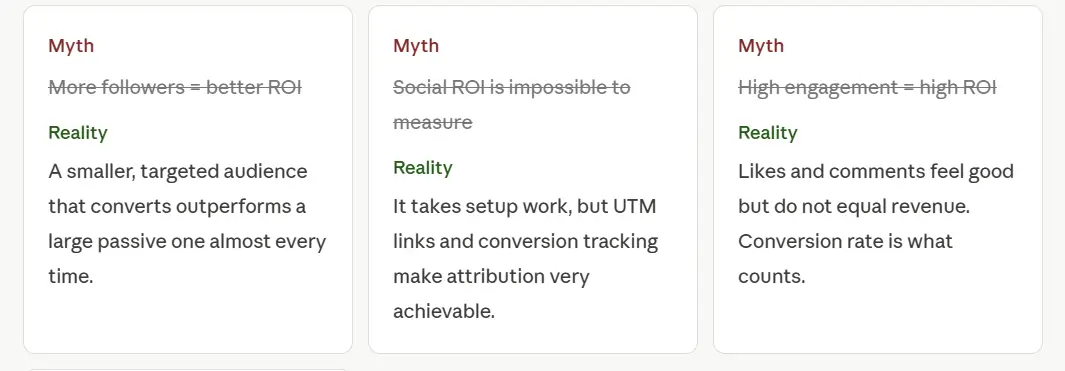
Before getting into the numbers, it helps to clear out the bad ideas that make ROI measurement harder than it needs to be.
The core ROI formula
The formula is simple and works across every platform, campaign type, and business model. There are two versions pick the one that fits your goal.
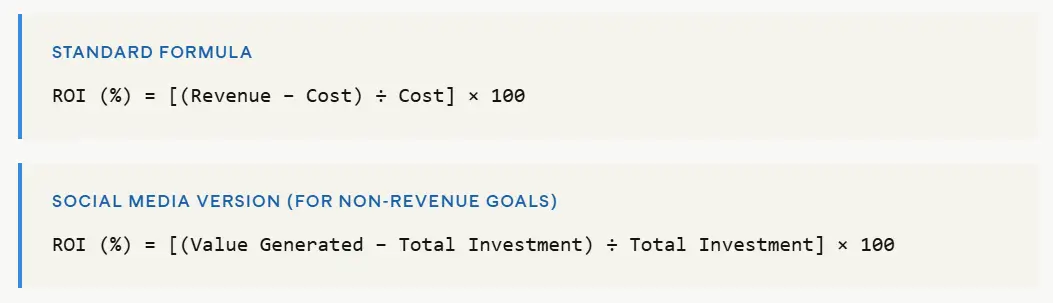
A positive result means you made more than you spent. A negative result means costs outpaced returns. Anything above 100% is genuinely strong for social media it means you more than doubled your money.
Step-by-step: how to calculate it
Follow these six steps to go from raw data to a clean, reliable ROI number.
- Step 1 — Define your goal. Sales, leads, sign-ups, or traffic. One primary goal per campaign.
- Step 2 — Add up all costs. Ad spend, content creation, software subscriptions, and staff hours all count.
- Step 3 — Assign a value. Put a dollar figure on each conversion, lead, or outcome type.
- Step 4 — Measure returns. Use analytics to count revenue or conversions coming from social traffic.
- Step 5 — Apply the formula. Subtract costs from value, divide by costs, multiply by 100.
- Step 6 — Act on the result. Scale what is working. Cut or rethink what is not converting.
Key metrics to track
Skip vanity metrics like follower counts and impressions. These are the numbers that actually connect to business results.
- Revenue per campaign — direct sales tied to a specific post or ad set.
- Cost per lead (CPL) — total spend divided by leads generated.
- Conversion rate — percentage of social visitors who completed a target action.
- Customer lifetime value — long-term revenue from customers acquired through social.
- Click-through rate (CTR) — clicks divided by impressions. Measures creative relevance.
- Return on ad spend (ROAS) — revenue generated per dollar spent on paid ads.
Real worked example
A fashion brand runs a 30-day Instagram campaign for a new collection. Here is the full breakdown.
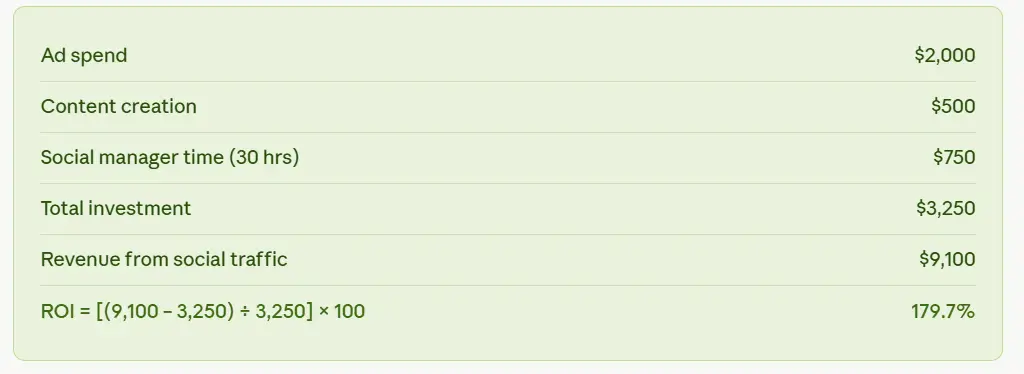
For every dollar spent, the brand earned $2.80 in profit. Below 0% means you lost money. Between 0–100% is break-even territory. Above 100% means real, scalable profit.
ROI by platform
Each platform attracts different audiences and drives different types of conversion. Put your budget where your customers actually convert.
- Instagram — strong for e-commerce and product discovery. Visual format drives purchase intent.
- Facebook — best for retargeting, local business, and event promotion. Deep ad targeting options.
- LinkedIn — higher cost per lead but closer to actual buying decisions for B2B audiences.
- TikTok — exceptional organic reach. Best for brand awareness and younger demographics.
- Pinterest — high buyer intent and long content lifespan. Works well for home, fashion, and food.
- X (Twitter) — real-time brand voice and customer support. Lower direct conversion, higher trust building.
When to measure ROI
Measuring at the wrong point gives you a misleading number. Here is a simple timing guide.
- Week 1 — confirm tracking is working. UTMs firing, goals registering, pixels live.
- Week 2 — check CTR and cost per click. Adjust creative or targeting if numbers are off.
- Week 3 — first real conversion read. Calculate preliminary ROI against your target.
- Month 1 — run the full formula. This is your number to report and learn from.
- Quarterly — compare all campaigns. Look for patterns by platform and format to guide next quarter’s budget.
Common mistakes to avoid
- Leaving out staff hours and tool subscriptions these make ROI look better than it actually is.
- Skipping UTM parameters without them you cannot attribute conversions to the right channel or post.
- Measuring too short a window a 7-day report on a brand campaign will almost always look weak.
- Chasing follower counts instead of conversion data a smaller engaged audience outperforms a large passive one every time.
- Comparing ROI across different campaign types a lead-gen and a retargeting campaign are not the same thing.
- Not assigning value to non-revenue outcomes every sign-up and download has a financial worth. Use it.
The bottom line
Social media ROI is not a complicated concept it is a habit. Define your goals clearly, track every cost honestly, assign a dollar value to every outcome, and run the numbers on a regular schedule. The data will always show you what is working.
Ready to run your numbers? Try the free calculator at socialmediaroicalculator.com →